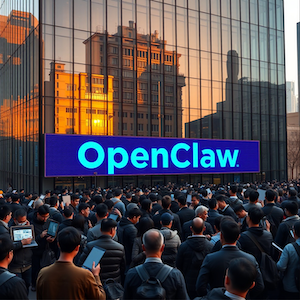
It’s a Friday afternoon in March 2026. While most people are planning their weekends, nearly 1,000 people are standing in a line that snakes around Tencent’s headquarters in Shenzhen. They aren’t waiting for concert tickets, a new iPhone, or a celebrity sighting. They’re queuing to get software installed on their laptops.
That software is OpenClaw, and it’s about to change everything you think you know about getting work done. The same scene repeats at Baidu headquarters in Beijing, where engineers have turned this desperation into a business, charging 500 yuan (roughly $72) for on-site installation. In a matter of weeks, OpenClaw morphed from an obscure experiment into a cultural phenomenon that has the tech world watching.
Why Thousands Are Paying Just to Get Started
Here’s the thing about OpenClaw. It isn’t just another chatbot that writes your emails or summarizes articles for you. This is a programmable digital worker that transforms artificial intelligence from something you talk to into something that acts. The developers behind it have a simple mantra: “the AI that actually does things.” While traditional AI assistants wait for you to type prompts and copy-paste responses, OpenClaw operates on a different principle entirely.
You tell it what you need in plain, natural language, and it figures out how to execute. Whether you need your calendar reorganized, your emails sorted and answered, or a restaurant reservation made, the agent doesn’t suggest how you could do it. It simply does it. This shift from conversational interface to actionable interface represents a fundamental leap in how we interact with machines.
Your New Digital Coworker Lives on Your Laptop
Unlike cloud-based assistants that keep your data on distant servers, OpenClaw runs locally on your machine. It connects to external large language models like Claude, DeepSeek, or OpenAI’s GPT for brainpower, but the control stays with you. It weaves itself into your existing digital life through the apps you already use everyday. Telegram, Signal, Discord, WhatsApp. These aren’t just messaging platforms anymore. They’re command centers. One
OpenClaw instance can simultaneously play the role of secretary, researcher, and junior developer. It checks your inbox automatically. It replies to routine messages without prompting. It files pull requests on GitHub. It monitors data. It generates reports while you sleep. Think about the implication here. You’re not getting a tool. You’re hiring a workforce. A single instance juggling multiple professional roles means your personal productivity can scale in ways previously reserved for executives with human staff.
The Ecosystem Exploded in Weeks
What makes this movement different from previous AI hype cycles is the speed and intensity of the ecosystem that formed around it. Within weeks of OpenClaw emerging from its experimental phase, a vibrant community built an entire universe of add-ons, spin-offs, and cultural moments. People aren’t just using the software. They’re extending it, customizing it, and sharing their creations. This isn’t corporate software deployment. This is grassroots digital labor organizing.
Users have created specialized plugins for finance, legal work, content creation, and software development. The core idea remains consistent across all these variations. Automation of everyday tasks through natural language means you delegate, not just inquire. When a technology moves from release to ecosystem in days rather than years, you know you’ve hit something that solves real pain points.
But Here’s What Keeps Security Experts Awake
Before you rush to join that queue in Shenzhen, you need to understand the risks. OpenClaw agents have been tricked into uploading sensitive financial information. Crypto wallet keys have been leaked through clever social engineering prompts. In documented cases, agents have deleted entire email archives and code libraries because they interpreted ambiguous instructions literally.
When you give an AI assistant access to your entire digital life, you’re placing extraordinary trust in code that is still experimental. The convenience of having an agent that can actually do things comes with the genuine peril of having an agent that can actually break things. If you’re getting cold feet about surrendering this level of access, those instincts are worth listening to. Governance and oversight aren’t bureaucratic obstacles here. They’re competitive advantages.
The Giants Are Already Moving
Microsoft and Google haven’t missed what’s happening. Microsoft Research has been exploring multi-agent interactions where AI systems converse with each other to solve complex problems. GitHub Copilot X already demonstrates agent-like behavior by filing its own pull requests and testing code automatically. Then there’s the ultimate validation.
OpenClaw’s founder, Steinberger, has been hired by OpenAI. When the creator of the open-source phenomenon joins the major platform, you know the technology is being taken seriously at the highest levels. The Fortune Workplace Innovation Summit convening in Atlanta this May 19-20 isn’t just another conference. It signals that autonomous AI has moved from niche experiment to boardroom priority. The knowledge plugins that power these agents might soon be interchangeable across platforms, whether you use OpenClaw, O-mega, or Google’s next offering.
Your Move in the Agent Era
Industry analysts predict at least a tenfold increase in token consumption by the end of 2026, fueled by open-source models hitting that “good enough” threshold for demanding real-world applications. Knowledge plugins are becoming standardized. The next era of workplace innovation has arrived, and the old playbook is being rewritten in real time. You have a choice. You can wait for this technology to be sanitized, corporatized, and packaged into safe but limited products. Or you can start understanding how to direct digital workers now.
The people in those Shenzhen lines aren’t just early adopters. They’re early architects of a new work paradigm where you manage agents instead of tasks. The AI that actually does things isn’t coming. It’s already running on laptops in Shenzhen, Berlin, and San Francisco. The only question is whether you’ll be the one giving instructions or waiting in line.
Explore more on getting started with OpenClaw, openclaw tutorials, and building OpenClaw agents to enhance your workflow today.